Thursday, July 29, 2021

Active Learning and POGIL

 It is common to say things in a way the remind us of Yogi Berra's quotes. For example: " Nothing difficult was ever easy" is claimed to be one of his quotes.

"Active Learning" is one of those as by definition learning is an activity. There is no opposite or any other way, can you imagine passive learning. The idea of course is to make a difference between learning through listening to a lecturer, where the learner appears to be passive, not moving, not asking questions, not even taking notes. Just thinking. Thinking then becomes a passive state as if the thinker is doing nothing.

Let's think about this for a moment.

As I am typing this essay and thinking about "Active Learning" I am being creative, or al least trying to be, and imagining a situation in the classroom where I teach. I share with my students some background of the topic, some historical introduction if needed, some connections to other subjects in the course, the topic itself, and asking them to think. One way to ask them to think, is me asking questions.  Questions like: Do you have any questions? Can you please ask me a question? If the topic or idea involves some mathematical solutions then I can ask a question related to the solution of a problem, based on the equations developed during the lecture.

This format is what is normally not defined as "Active Learning". So what we can do is to turn things around and start by asking a question, by setting some framework to the question, and then ask the students -by themselves or in groups- to develop the answer and theories behind the answer. Such an approach is named POGIL in chemical education. It stands for Process Oriented Guided Inquiry Learning. For more information about POGIL click here.

With different names similar approaches have been developed with great success, one worth mentioning is David Sokoloff at the University of Oregon who has worked for many years in physics education. The main idea in STEM is the hands on experience. The need to do real experiments, beyond the typical demonstration, where students gather data and learn how to interpret it to the degree where laws can be created to explain the results observed in the experiment. For more information about Active Learning in Physics click here.

Now we face a new challenge with online teaching, how can we make STEM education active online when the instruments to perform experiments are not widely available? What kind of video resources can be produced to replace the hands on experience? This is a challenge that we all are facing, and many great educators are busy working and developing new materials, many of which will prove to be invaluable resources. The COVID-19 pandemic has been a tragic event but we can get something good from it, specially in education. Now hybrid platforms are being created that will help a wide variety of students. Students with different needs that before were boxed in to a single, uniform, educational setting. Now students and teachers will have options in their communication. Asking all the time, are we being active learners?


Sunday, February 14, 2021

COVID Innovation


The Curiosity Rover 

SARS-2/COVID-19 has been the most traumatic worldwide social experience of, at least, the past fifty years. The pain and suffering both individually and collectively as many people around the world have suffered the illness and in a way, too many death has been superlative. The economic collapse has been, as well, individually as collectively devastating. No doubt about it.

We should not minimize the devastation but we must, also, see the opportunities. We must not be defeated in our spirit or our souls. We must keep finding ways to make things better and to help our society to improve. This is where science education in particular and education, in general, play an important role. This is a unique opportunity to innovate. To innovate how we teach and how we learn. We can't continue in the XXIst century teaching based on XXth century methods and programs. Institutions of learning have to be transformed radically to meet the needs of our society today. In many ways, large research universities have made changes but in a way, these changes are insignificant compared with the task at hand. Some small Liberal Art Colleges are not surviving due to the demands of this new paradigm. 

As I think, Yogi Berra said: "The future ain't what it used to be".  We can't use the past to guide us without analyzing when and how history will repeat or transform. Some have said (Couros. 2015 page 12) that we are living in a "Printing Press" moment which can be a strong metaphor as there are more than changes in the system of production there are elements of change in the mentality of the citizenry. The new iGeners born and raised in the midst of the information technology age aka the internet are being educated following pre-internet methodologies even though educators are using information obtained there. Education is more than the information provided, information that can be obtained at a minimum cost. What education institutions must provide today is the nurturing of curiosity. The atmosphere and platform for individuals to create and innovate. Guided by experienced individuals who can help, mentor, and direct. This is the new role of the professorship in higher education.

 Science has always been about curiosity. This is why teaching science is so apt for the changes in education. For many years teaching has worked against curiosity in the name of curricular content. Teachers are used to replying to students' inquiries with "wait a moment I have to cover this topic we talk about it later" and "the later" never comes! Curiosity is delicate, easy to break and nullify, it is imperative for teachers to nurture creativity through reinforcing curiosity.


Monday, December 21, 2020

Predicting the Future and the Scientific Method

    It is time for an old draft to come to light. I started writing it several years ago, as you can see but it appears that it is now that becomes more appropriate.
    On August 21st, 2017 we in the USA experience a natural wonder. A total Solar eclipse. The shadow of the eclipse narrow band spanned across the whole northern USA from Oregon in the west to South Carolina on the east coast. This event was special for many reasons and gave us the opportunity to think about the wonders of the natural world.
    As I prepared for my presentation at Warner Pacific University where I guided people through the phenomenon as it was occurring, I started thinking about how humanity has experienced solar (and lunar) eclipses and how metaphorical they have become. The first experience of course was un-expected and the explanation for the event was metaphysical, attributed to supernatural forces, and some eclipses became the signal for some ominous event. But then science happened.
With scientific knowledge a sense of predictability came, if one knows how something works, say the solar system, then future events (like eclipses) can be unmasked and previous events can be explained.    
"Total Solar Eclipse 2017 Path USA Map" by NASA Goddard Photo and Video is licensed under CC BY 2.0


    This for me is the power and importance that science has. Being able to predict.

    Predictions even though may appear simple they can be misrepresented or they can become the force to cause the prediction (a self-fulfilling prophecy) or they might be the cause that what is being predicted doesn't occur. For the first case, I can mention how as I was explaining the eclipse with a map of the USA with a shadow of where the eclipse would be seen some people misinterpreted the map thinking that the eclipse would be occurring at different times in the US as in the map the shadow was marked with the time. So if it was 9:00 AM in PDX it would have 12:00 PM at NY. People would interpret that as if the shadow of the eclipse was moving from PDX to NY taking three hours to get there not realizing that, in fact, 9 am in PDX is the same time as 12 noon in NY; even the caption in the picture talks about a path!
    The second kind of prediction where we have a self-fulfilling prophecy is when an economic model predicts that there will be a scarcity of some product, as we saw in recent times with the COVID-19 pandemic and toilet paper, causing citizens to hoard toilet paper and thus scarcity. 
    The third kind of prediction is when people react to the prediction thus making the prediction fail. That is the case of the movie Soylent Green that predicted in 1973 that NY city would have 40 million people by the year 2022. This prediction was on a film that represented the feeling of society at the time and was based on statistical projections based on good data at the time. What did happen then was that people realize that the future exposed on the film was not what they desired for their lives and therefore stop moving to NY creating a new trend that made the initial prophecy fail.
    Today, in the midst of a pandemic, we are wondering about the immediate future and the long term. How can we know what kind of future are we creating with the actions we are taking now? Are we going back to normal? Are we going to create a new normal?
    The answers to these questions will take a lot of discernment. But one thing I am sure of is that science should have a central role in decision making. We need to learn how to interpret data obtained by different means. We need to view the environment as integral to our own human existence. We can't forget how everything is connected and how wrong and stubborn ideologies will backfire.
    As a teaching professor in STEM, I feel especially obligated to ask these questions and to help my students develop critical thinking so they will not fall prey to conspiracy theories abundant today in our cyberspace. 
    

Tuesday, June 9, 2020

The Truth Abaout Test Scores and Grades

It has been a long time since I blogged about science teaching and science education. It is not that there are no more things to talk about, but because other things have come my way, distracting me from this topic. So today I am returning to writing about it because the times require an examination of the situation, in particular to online education.
Halfway this past spring semester 2020, in the USA we had to change the way we do school due to the Coronavirus pandemic. The change was dramatic and affected all around the world. In our case, the main change was that we had to deliver instruction via the Internet. Unintentionally other aspects of the life of the student were affected as well, like for those who were graduating and couldn't get the proper commencement celebrations. For me, one thing that stood out was the way we do the grading of a course, and of course for the students as well. That is why I need to articulate some ideas about grading.

What is it about grades that get in the way of education?

Is it the social stigma of a "good grade" that inhibits the performance of students as they focus more on them than on the actual knowledge, Skills, and Convictions that are supposed to be what education is all about?
Let's focus on STEM education. Science, Technology, Engineering, and Mathematics have been the driving force of progress. Medicine and in general the wellbeing of our society depends on well-trained professionals in these areas. Many students, young and old, are getting into STEM because they see a bright future.

What are the proficiencies that education is to develop?

These questions are difficult to answer, as the socio-economic conditions framing the context of the relationship between students and their learning is very complicated, it is a complex environment. The complexity comes from the multiple dimensions of the situation, starting with who the student is as an individual, and who is the student supposed to be. Who is the student as a product of his/her environment, and who is the student supposed to be as a product of his/her environment?
Where is the student coming from?
What is the student's background? And, even more difficult, where is the student going?
Where is the student now?
What is the context that the educational institution provides for the success of the student?

Science students, in particular, have to face a series of prejudices, misconceptions, and lies.
On the one hand it has been traditionally supposed to be an area for exceptional, rare, mainly white males, individuals who must sacrifice an open and fun life like any extrovert would enjoy. "In the good old days" these individuals couldn't be good looking, socially active, nor popular with their peers. They were labeled as "nerds."

Making scientists social heroes has been an uphill battle for many years. Few in the past have obtained recognition when due to a social crossroads the moment is right. But in general, it is the economic success of those in STEM that makes it attractive to study.

Coming back to misconceptions. Having a good grade average has been the myth of success. Many students believe that in order to get into a recognized institution to obtain a diploma that allows them to enter the work-force at a high level of income, they need good grades. To the extreme of thinking that an average grater than 3.5 is necessary in order to succeed. This is a major impediment in students' performance as thinking about the grade blocks the student to thinking about the subject matter. The stress of the possibility of getting a low grade highly inhibits the potential of understanding the material that they have to master in order to be able to perform professionally.

That is the main issue with grades as obstacles for proficiency.

Saturday, July 15, 2017

Teaching Something Old That Feels New

It is easy to become comfortable when teaching a subject for several consecutive years, so what can one do in order to keep it fresh? Keeping it fresh is not only desired for the sake of the teacher's interest and mental sanity but most important for the feeling that the class is uniquely developed for the present students. Students need to know that they are learning something that is important to them individually. Students need to know that they are learning something that is for their present interests and use and not something old that belongs to the archives of history, unless of course is a history class.

We are here talking about teaching science, science that has old principles, old hypothesis, old theories, and old methodologies. Of course there is the science that is at the frontier of knowledge which normally is an upper division class. Now let's have a discussion of the problem when teaching a lower division class. Some of these old ideas, such as distance, force, vectors, pH, stoichiometry, et cetera are extremely important and are required knowledge at any time so how can we make them fresh?

There is also the question of how deep one has to go? As we think about the knowledge necessary for a particular level. As one difficulty we have up to now is the lack of definition of what a 100 or 200 level courses are in college. So for the time being let's talk about these two levels as one category named "lower division". Let's start with defining the level of lower division as the one where basic nomenclature, basic historical connections, and basic parametric relationships are taught. From the pedagogical point of view there has been a change in recent years in the sequence of the way this concepts are introduced in class, it used to be (and in some cases still is) that teachers would start with defining terms, say in physics teachers would start with units. Now teachers following the active learning or guided inquiry learning methodology start by asking questions and along the way they introduced the vocabulary necessary for the discussion. This a pedagogical methodology that has been developed for a few years more so now with the help of the Internet where flipped learning is becoming more widespread.

With this in mind one can see how with the use of recent technologies like the Arduino or Raspberry Pi students can lear about information and communication technology by playing with these.

Can students use these "toys" to learn about physics, chemistry, or biology?
 

Thursday, May 11, 2017

Priming

Painting can be a metaphor for teaching. The painter start with preparing the surface on which the paint is going to be applied as students have to be prepared for the instruction and knowledge the teacher is going to administer.


Recent discoveries in Psychology pioneered by Kahneman and Tversky (Prospect Theory) have shown that the way we think is modulated by our emotional state. The old metaphor of the personality being a horse carriage where the horses were the acting emotions and the logic intellect (the mind) was the guiding influence in our behavior was displaced by a new metaphor of an elephant and its rider. An eloquent account of this new metaphor was clearly articulated by Jonathan Haidt in his book "The Happiness Hypothesis." We now know that controlling emotions is like threading water, like guiding and elephant. This is a critical aspect of the teaching-learning dichotomy in the context of a classroom that has been set based on the old paradigm.

Students come to class with a variety of feelings, from excitement for a new experience to apprehension for the unknown and their previous negative experience in the classroom. Over all there is the pressure that students have based on the grading scheme used in today's system of education. Grading which is supposed to be objective and in reality has a big component in subjectivity. This subjective aspect is based on the reality of the behavior of both teacher and student. These of course will be, as mentioned before, highly emotional.

The metaphor of painting as education allows us to think about the steps taken during the class to impart information, and educate students to be able to acquire the knowledge for the subject of the course. The learning has to be done by the student, not by the teacher. The teacher is there to guide the process by which the student learns, so it is imperative that the teacher is somehow aware of the emotional state of the student. This is where priming comes.

In art priming is the process by which a surface is prepare for the painting. Paint layers that will bring not only a new appearance to the object that is painted but will give that object a new meaning. A canvas becomes a piece of art. Painting is more than just adding paint. Painting is transformation. This is the whole idea of education. This is where the metaphor makes sense!

So when a painter is ready with an idea and a canvas the first thing she does is to prepare the canvas, to prime the canvas. This is done by applying a special coat of special material, the primer, that will bring the surface of the canvas to be ready for the paint. Two aspects in the "ready for the paint", one is to protect the underlying surface and the other is to remove any imperfection.

What would the priming look like in the class room? How would this priming prepare the students and remove imperfections?

What I have tried is the following. First address the mood by being happy beyond a simple greeting, happy in the recognition that is always a blessing to be able to learn, to be in a situation where peace and safety are guaranteed. I use candy and birthday celebrations to make students feel welcomed and aware that they are now in a new setting. In Dr. T.'s classroom.
Second. They take an attendance quiz, which is a review of topic covered in the previous class and will not only remind them of the subject but remove any lack of understanding (an imperfection) that imperils their ability to continue learning.
After it is clear that students understand the questions on the attendance quiz, I mention the importance of the subject matter as it relates to their lives. We work on their use of calculators and relevant math to help them feel confident that they can solve this problems. Building confidence becomes one of the main purpose of the priming. A secondary benefit of this kind of priming is that the attendance quiz which returned the following class can be used as a guide for taking exams.

As the primer is not paint, in class the activity chosen for priming might not be related to the lesson. For instance (happiness) blowing bubbles changes the mood, singing "happy birthday" to someone celebrating changes the mood, or just a piece of candy will do it too.

If you have any ideas about priming in class, will you please share them with me?        

Tuesday, May 2, 2017

The T equation

In science we have many numbers, constants, equations, formulas, laws and principles that have the name of someone who invested a long time studying the phenomena related to the former. It is hard to know how long they stayed looking and learning about what they were studying. In most cases it doesn't matter. When dealing with pressure we have the unit Torricelli (torr) in honor of Evangelista Torricelli who invented the barometer. I don't know but it is not hard to think that the invention took many long hours to take place and to improve until he was able to have a working instrument. While he was doing this he was also thinking about pressure. How can it be defined? How can it be related to the forces involved? How can it be related to the area? et cetera. [By the way the pressure of the atmosphere at sea level is about 760 torr.] So the names associated to these constants, units, laws, et al. are in a way a representation of the effort of those individuals and the societies where they lived.

There is also the fact that naming things makes it easier to remember. It has been studied that when someone is presented with two individuals, one named Baker, and the other being a baker. It is easier to remember the fact that one is a baker rather than the name of the other. If you want to know more about this read the excellent book by John J. Medina "Brain Rules".
One very useful equation in buffer chemistry is the Henderson-Hasselbalch equation:

pH = pKa + Log(Base/Acid)

that relates the pH of a solution made with a weak acid or base and its conjugate acid or base. As it is known in chemistry by definition the mathematical operator p stands for the -Log.
So the pH can be calculated from the concentration of the Hydronium ion H3Oby calculating the -Log,

pH = -Log[H3O+].

The Ka or equilibrium constant for the acid base reaction is calculated from the concentrations of the products and reactants in equilibrium using the following relationship:

Ka = [H3O+][Base]/[Acid] with this relationship and using the properties of Log functions such as Log (AxB) = Log A + Log B. One can derive Henderson-Hasselbalch equation.

Now, traditionally when one is trying to calculate what is the change in pH when a small amount of acid or base is added to a buffered solution one calculates the pH before and after the change occurred, it easy to do by using Henderson-Hasselbalch equation twice, and calculating the change by difference.
I have developed a shortcut by doing the following: First I make the point that I know both concentrations, the initial and the final concentration of both acid and base. I will call them Ai, Bi, Af, and Bf. (The final concentrations of course can be easily calculated as we know the initial concentrations and the amount of acid or base added to the solution. Let's not waste time here with an example of how to do it.)
The change on pH of course can be written as the difference between pHf - pHi

ΔpH = pHf - pHi

If we use the Henderson-Hasselbalch equation twice in the previous equation and use the properties of Logarithms we can get to the following condensed equation to calculate the change in pH:

ΔpH = Log (Bf * Ai)/(Bi * Af)     This is the T equation!

This very simple equation states that the change in pH is the Log of the product of the final base times the initial acid divided by the initial base times the final acid. Even though we should be aware of the values of the initial and final concentrations the fact of the matter is that as long as we have the acid and base cross multiplied, i.e. if the base is the initial the acid must be the final, the only difference if we do them vice versa is that the sign of the difference will change from negative to positive or vice versa. Which in reality doesn't matter because we normally want to know the absolute value of the change in pH. We know that if we add a base the pH will increase a bit, and if we add an acid the pH will decrease a bit. But what we are interested is in the absolute value, the magnitude of the change.

Thursday, January 12, 2017

Linear Thinking and Hub 4 CIS^2

In his book "The Biology of Belief" Lipton does a great job shifting the paradigm of nucleo-centered biology to membrane-centered biology and uses quantum physics as a powerful tool to argument for the shift. (For a Youtube video of this book click here) The importance of this new way of looking at how cells function is that it gives the environment a critical roll in the behavior and development of cells and organisms in general. Environmental stimuli are critical in the way we think. In a similar way John Medina in his book Brain Rules tries to articulate principles that explain why the mind works the way it does. (To see the rules click here.)
When one thinks about how to learn something or how to teach something we normally assume many things and ideas that should not be assumed. For instance the fact that we are all different, we are different at the nanoscopic, microscopic, and macroscopic levels, meaning that there is a genetic, organic, and environmental difference. Paradoxically we all -at the same time- aspire to unity, homogeneity, and similarity. How can we work with this paradox in education? It really looks like the old nature versus nurture dilemma but it is not. This paradox provides with an integrative approach to understanding how we survive and thrive in our work, family, and society in general.

Changes require changing, as I belive Yogi Berra would say, so what kind of changes do we have to do in order to have a positive influence in the changes that inevitably are going on.
So far linear thinking has guided us here. In many ways our society is based on linear thinking, but that is not longer (maybe hasn't been for some time!) the case. We need to thing more organically. We need a non-linear -web like- way of doing things. The Internet has proven the efficiency of this model. But has also opened possibilities for wrong doing. This is where there is a very important role of education in guiding the changes that are occurring.
 
I have developed an idea for a setting; an idea for a context and an environment. I call it Urban Hub 4 CIS2. Urban Hub for Creativity, Innovation, Sustainability, and Stewardship. In this Hub 4 CIS2 people will join others in their pursuit of learning. Means and attitudes will be there to help all who want in the achievement of their goals. Including of course academic and vocational counseling to those who need it as some will need some help in defining their goals, objectives, and aptitudes to accomplish them. Students will flourish as they find their strengths and institutions will prosper as they increase the efficiency in which they serve their constituents. It is a win-win-win proposition. The individual wins as s/he becomes more involved, aware, and engaged with is his/her (hir) success. The institutions win as they become more effective, solid, and sustainable. And, of course, we all -society- wins as it becomes more just and equilibrated.   

Sunday, January 8, 2017

More Trust

It has been a long time since I posted on this blog, and it was about Trust. In it (click here to review) I mention how leadership is based on trust. But then I was not thinking so much about institutional trust, the trust that people have on institutions. Indirectly of course there is a relationship between personal/individual trust within an institution and the trust that refers to the institution. Now I want to address how trust in the institution affects the way we trust each other. In particular the trust that is necessary between educators and students to guarantee student success. (If there is any way to guarantee student success it is through trust.)

As we live in a continuous changing world we have to be aware of types, and areas where these changes are taking place. This analysis and awareness is difficult because the orthodoxies of life give the impression that there is some stability and the Status Quo dominates our actions, behaviors and aspirations. There is a strong inertia in our ability to read history and to understand who we are based on were we have been. Specially when, regarding education, there are norms established by accreditation institutions.

At the forefront of changes in education is the one related to science. STEM not only has fed changes with a lot of energy but in a way it has guided the direction in which these changes have occurred. Changes in medicine, energy, transportation, communication, and in general how we relate to our environment. We can't continue teaching science in the same way we have been teaching for the last 300 years. There are some paradigms like the definition and use of the scientific method that can and should continue to be adopted, but the delivery of these paradigms might (most like shouldn't) be different.

Paradoxically it looks like some of the changes that are occurring appear to move backwards. To some kind of original intent in our society. For example it looks like we are going back to the idea of personal prestige rather than the prestige of the institution. We have never lost the personification of some institutions as we clearly identify individuals with some corporations. More so if this institutions are of recent creation, say Microsoft is clearly identified with Bill Gates, but with older institutions where their founders are long gone is not that easy. Who can identify a person with GM, GE, Ford, MIT, or Harvard? If you are not in that area of business for sure you will not know who is in change of these macro-organizations. Who knows who control Twitter, PayPal, Uber, Airbnb, or the WWW? Again if you are not in the business you will not know. But... For sure you know what these are and what do they do, as most likely you are one of their users. (Note that I didn't mention Facebook!)

A recent TED talk by Rachel Botsman (Jun, 2016) discuss the implications of technology on the way that we trust each other, the way in which we grade and evaluate each other, including services provided by institutions. This is having a direct impact on the way we learn and teach. We now have institutions providing information and knowledge that in some cases is certified through MOOCs. These courses and certifications are from well established (accredited) institutions such as MIT, and others through their own systems of delivery (MIT OpenCourseWare) or through independent delivery systems such as edX, Coursera, and others.

Now, the question is how can we be ready for these changes. As an academic my interest has been on how can I be a better teaching professor? What kind of organization is better to confront the challenges of today? How can I be part of the strengthening of the organization? The answers to these questions are complex, and require deep analysis. But most importantly the answers require a sense of hope and optimism.

As an organization we have to become in many ways what Brown-McNair et al. in their book "Becoming a Student-Ready College".


A body of people focused on serving a diverse population of students.

Friday, October 2, 2015

Trust

Over the years humans have developed ways of relating that is chemically based on hormones of love, compassion, gumption, and trust. Oxytocin has been identified as the chemical produced in response to the feeling of safety and protection one get when living in a community where the leader is satisfying their needs.
In the classroom we have a similar situation when learning something that is challenging. The leader, in this case the teacher, has to make sure that students are aware of the value, the 'worth' of their education. Teaching science is specially challenging due to the complex nature of its language, not only math is involved but particular nomenclature and vocabulary that comes from an intricate historical evolution.

In his book 'Leaders Eat Last' Simon Sinek explores the importance of understanding the relationship between how one feel in some environment (like work) based on the behavior of the leaders of that environment. Underlying this behaviors are chemicals (Endorphins, Dopamine, Serotonin, and Oxytocin) generated by our body. For a short version of his book have a look at his presentation in Youtube
 https://www.youtube.com/watch?v=ReRcHdeUG9Y

So why am I thinking about this in relationship to my teaching?

It seems clear to me that when students come to class are in search among other things of a leader. The teacher as a coach has to be dependable and more important has to be a leader. A leader that has gain the trust of their students.

Wednesday, September 2, 2015

New Ideas for The New Academic Year

Over summer I had the opportunity to read a lot about teaching in general and in particular about higher ed. The two main areas in pedagogy that made an impact on my thinking are: constructivism and individualism.

The first one, constructionism (constructivism), refers to the idea de we learn building on top of other ideas. As more complex phenomena is understood based on the relationships that it has with simpler experiences.

The second one, individualism, is based on the idea that we all are different and thus have our own ways of learning new concepts. This last area has to be viewed within the context of the similarities that we have just because we are humans and our brains basic functions are the same. The subtle differences then come not from the basic functions but from how this basic functions relate.

The problem is that these relationships are non-linear and in our organizations we have a lot of linearity like the way we design courses in the 100, 200, and higher levels. One may assume that the 100 level is for nomenclature development, while the 200 level allow for the solution of problems that require quantification. Higher levels will introduce the synthesis and analysis beyond quantification but including it.

As I am teaching General Chemistry at the 200 level and Organic Chemistry at the 300 level, I can put into practice these ideas and as I move along I will write about it giving specific examples.

Do you have any examples of these ideas.

Friday, May 29, 2015

Continuously Changing Learning Objectives

Teaching science is challenging for a lot of reasons one of which is that learning objectives are shifting with changes in our scientific and technologic reality. Take for instance the development of robots. Robots have been in the mind of futurologist, technologist, and industrialists since the beginning of the industrial revolution (maybe before) mainly to replace humans doing unpleasant tasks.

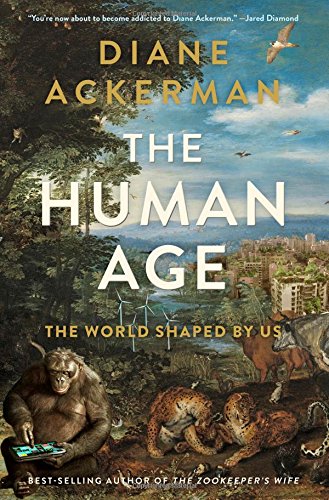
Reading Diane Ackerman's book The Human Age I am exploring the idea of the possibility of self aware robots.

Image form Amazon
This exploration made me think about the problem of teaching a subject like chemistry that is being transformed by the use of "artificial" intelligence. Computer models that can replicate chemical reactions and gather data that is retrofitted to the algorithm so through many fast iterations a final reactant can be identified as the best. For an example of a computational drug design look at this youtube video 


In this video you can see as the molecule is modified to fit in the dock the enthalpy of the hydrogen bond which is a measure of fitness is calculated and displayed.

Of course these experiments can't be done by someone without basic knowledge of bonding, atomic and molecular orbitals, molecular structures, and thermodynamics. But all of these concepts are there in cyberspace and constitute 'knowledge' that is universally shared. The main problem is that now there is no way we can teach everything that is available in any branch of science, like it was the case a century ago. The issue, for me, becomes how to structure a systematic process where students will learn basic concepts that include how to get the necessary information from the internet. The cloud becomes the hub where students transit for the interconnection of ideas and tests. Hypothesis are explored in this new environment where collaboration becomes the norm and communication (including of course the proper language) the most powerful tool.

So, the question becomes: how much time should be invested in learning and developing searching and communicating skills?


Thursday, May 14, 2015

What is there in the vocabulary

     One may wonder why is having a broad vocabulary important in science? How would understanding the meaning of a word helps grasp the concept referenced by the word? Is the understanding of the meaning of a term necessary to solve problems where the term is invoked?

     These are not trivial questions, but it appears that they are, based on the fact that we use a lot of terminology which meaning depends only in the context where the terminology is used. For example let's think about the word "attraction". Take a moment and think about the word. Then you realize that in order for you to thing about the word attraction you have to construct a sentence like: two bodies experience gravitational attraction due to their mass. Or, two bodies feel romantic attraction due to their psychological compatibility.

     Are these two examples of attraction similar? I dare to say, no! They are very different with respect to the way that the ideas of force and feelings have completely different mechanisms thus the solutions to the problems presented in each case will have very different results and conclusions. Let's expand this argument for the sake of clarity. In the case of gravitational attraction one knows that the force is proportional to the mass of the bodies involved. Therefore one can write a formula that simply states this attraction as a function of mass like this: Force of attraction between to bodies at some distance is proportional to the product of the masses of the bodies. F(at some distance) ~ m1*m2  or F~m1m2; where m1 and m2 are the masses of the bodies. The next step is to remove the proportionality symbol ~ through experimentation and change the proportionality to an equality like the following where the distance factor is introduced: F = k (m1m2/r2. The r2 indicates that the force decreases with the square of the distance r.

Now let's try to do the same with the romantic attraction. What factors would we use for the 'psychological' feeling that these two bodies experience, can we talk about these feelings like forces?
Or the metaphor will completely get out of hand? The opposite was the case when in the seventeen century Isaac Newton suggested that two bodies 'attracted' each other through gravitational forces. 

The French much given to romanticism were completely opposed to Newtons ideas for many years because they could not come to terms (pun intended) with the idea that inert bodies like rocky planets could have feelings and 'attraction" was before Newton used in the sense of the later example. Now of course we have blurred the line between the metaphorical meaning and the 'literal' when we use the term force to indicate desire, need, or even thought.

So what is there in the vocabulary? Why do we have to teach a bunch of terms in science classes?

How can the lack of understanding of the terminology involved in a particular discipline hinders the understanding of difficult concepts?

The answer to these question surely will lead to better pedagogy of science teaching and learning.

Do you have a term that is you favorite?

Saturday, April 25, 2015

The Anthropocene

Geologist have named geologic epochs using many names like "Holocene (recent)" in the Quaternary era less than 1.6 million years. For more information about geologic eras and the time scale you can click here. But it is time to name the present epoch based on the influence that we have as humans in the geologic record, so geologists from the distant future say a few million years from now will refer to. The Anthropocene is a good name, I have just read it in Diane Ackerman's book "The Human Age: The World Shaped by Us." To read a NYT review of the book click here.
The name has been proposed at least from the 1969's http://en.wikipedia.org/wiki/Anthropocene and it is supposed to imply that humans are in fact changing the characteristics of our globe in the same way that other conditions, mainly physical, characterized the other periods of geologic history. Like carbon (coming from living organisms deposited in strata) giving the name "carboniferous" (360 to 286 MA) period in the Paleozoic era. By the way this was for some geographic areas where the oil extracted now was formed.

What has this to do with teaching science?

For one it shows that vocabulary is important and nomenclature gives information about the subject. But most important is to see how everything is related and the historical-sociological-economical aspects of learning have to be taken into account when preparing a lesson plan. For the example above the use of MA (mega annum) for millions of years as a unit of time measurement is a good example of developing a vocabulary as we learn about the science in question. This developing of vocabulary has to be based first on previous knowledge and second on the time that it takes to practice using such a new concept. This need for having enough time becomes a critical element when dealing with class preparation. Apart from class preparation but related to it is the student's preparation. This is why is necessary to have clear and consistent sequence in the science curriculum. When students struggle with difficult concepts mainly because they don't have the basic vocabulary it is necessary for the teacher to slow down giving time for students to develop it. But at the same time the paradox arises when "time' is constrained to a syllabus giving a set content.

With today's diversifying student body this elements will have to be revisited and new structures, synchronous and asynchronous have to be developed.

My question for today is: Do we have time for this transition?
      

Saturday, March 21, 2015

The Joy of Learning -OK Google: What is an Arrhenius acid?

This past Friday (3/20/15) I started my G-Chem class by getting out my cellphone and asking it: What is an Arrhenius acid? ....The phone replied: "According to facultyfp.salisbury.edu an Arrhenius acid is a substance that when added to water ..." and continued with the whole definition including the definition of that of a base. So I asked my students: Am I here to tell you what an Arrhenius acid is? They moved their heads in the negative! Then I replied: "you are right I am here to tell you why you want and need to know about Arrhenius acids and bases and to help you make a connection between acid base chemistry with your whole life. This is one underlying principle of 'liberal arts' education. To see the context and to understand the relationships and connections of particular concepts within and without the topic on study.

Today's technology allows us to have instantaneous access to information, so information should not be the outcome of a lecture. It has been said that information is not knowledge, so class time should not be use to transmit information, it should be used to develop knowledge and to develop the skills necessary for oneself to create relevant knowledge. The teaching professor is there to guide inquiry and to set limits of time during the exercise of exploration. Learning science is complicated, I guess as learning anything that has many facets, but one can always try to stop the fragmentation of ideas through a holistic approach. Meaning that on can not separate individual steps of the solution of a problem with the overall context of the question being addressed. One can look at the solution of the problem as a simplified model or metaphor but one has to be conscientious of the fact that things are more complicated than that. Any particular and individualized solution of a problem has to be framed within a context and other consequences like secondary effects have to be at least noted, if not explored. This makes teaching science a difficult but enjoyable task, as challenges like puzzles are inherently attractive to the inquisitive mind. This is one important role of the science teacher: make challenging concepts appear like games in the journey that life is.

In my previous post, I mentioned the importance of 'joy' in learning, even to the point of saying: "If you are not having fun,... you are not learning!"
 It seems simplistic in the light of many that believe that things that matter have to be hard to learn, difficult to understand, and that should take a long time to comprehend. I agree but have some reservations about the attitude that one must have while going through the process of learning. And I am including the activities of teaching as part of the learning process. The teacher must be having fun as s/he teaches or s/he will not be able to have and create the energy to deliver a well intended lesson. It might be said that this happens all the time with everything we do in our lives, that no one person that is successful has been doing the things that leaded to the success with an attitude contrary to his/her joy and satisfaction. A recent blog at "Class Teaching" use a perfect metaphor with playing a computer game called Manic Miner.  https://classteaching.wordpress.com/2015/03/17/learning-with-manic-miner/ In this post Shaun Allison @shaun_allison takes a step by step approach to make a parallel between playing a game with several levels of difficulty and learning. It sure is a great pedagogical insight.

Saturday, January 24, 2015

If You Are Not Having Fun You Are Not Learning

Once in a while I remind my students about the joy of learning. Remembering this is very important when you are having a hard time learning new ideas. Ideas that are complex and difficult by their own nature and by the fact that it's not easy to contextualize them with our daily lives.
I have used the poem by Wang Ken "Song of Joy" as an inspiration to encourage my students to enjoy learning. I stress and emphasize this so much in my classes that in fact I call homework "Homejoy!"
  • Pleasure is the state of being Brought about by what you Learn.
  • Learning is the process of Entering into the experience of this Kind of pleasure.
  • No pleasure, no learning.
  • No learning, no pleasure.
(Wang Ken, Song of Joy.)

Many books and articles have been written around this idea, one in particular is "The Power of Mindful Learning" by Ellen J. Langer. (For more link here.)
And recently a new edition of "Experiential Learning" by David A. Kolb. (link here to read more.)

Of course we must not forget the seriousness of learning and the fact that it can be hard to do, but keeping in mind that successful endeavors require more than just the material means to accomplish, we have to remind ourselves that attitude is critical for success.

Did you see the Seattle Seahawks game against the Green Bay's Packers? 

A good example of how attitude -having fun- produces good results!  


Sunday, November 23, 2014

Skepticism and Science


Framing a context for the value of content.


Being a skeptic is for scientist a core state, the value of skepticism is rooted in the need of science to ask questions and on having in mind that whatever model we have now to explain a phenomenon is only temporary an it can, and most likely, change in the future. The interconnectedness between the phenomenon and the surroundings does not allow the invention of models to be separated from the anthropomorphic view of the person creating the model. Therefore it is necessary to see what is the context of the people developing these ideas. Culture in general and language in particular restrict and guide the construction of hypothesis and theories. 

Science education is more than teaching a set of rules given by theories or the transmission of content boxed in a set of models. Science education has to develop the connection with previous experiences in our society. These connections allow the student see how these ideas, hypothesis, and theories were developed and how they apply to our lives. As an example I can mention when teaching and explaining how the periodic table of the elements work I made the connection with my previous research on rare earths (aka Lanthanides) and the noble gases (aka inert gases). Not only teaching the names of these elements but having a story behind their nomenclature and behavior allowed the student get a feeling of discovery and a sense of awe of God’s creation. Knowing becomes an individual's integral status of relationship with his/her own history and environment.

What is necessary to know about the students when teaching science?
These students have gone to the traumatic experience of ‘directed’ education where ‘educators’ have induced in these students indoctrinated thinking void of ‘critical thinking’ which for the context of this writing is scientific skepticism. This scientific skepticism is so much needed in today’s society.

In his book "Think: Why You Should Question Everything" Guy P. Harrison (for a link to his website click here http://www.guypharrison.com/ ) warns about the lack of critical thinking in our society and teaches us that thinking like a scientist is the only way to avoid being swindled by crooks, kooks, and demagogues selling all sort of silly, and wrong ideas. Including commercial products that are harmful to us and to our environment. Being critical thinkers is a matter of personal security and wellbeing.

The need to develop critical thinking, i.e. skepticism in my students is what drives me to be critical and skeptical, and to teach with a sense of awe and feelings of discovery at every step even when the topic at hand seems to be old and fully developed like the idea of the periodic table. We know that the periodic table as it is normally presented is not at all perfect and even though is highly useful it need some explanation and adaptation. At the same time students need to know that new ways of presenting the idea of 'periodicity' of the elements (in some cases by the use of a 'table') are currently being developed as this link shows. Click here for the link.
  
The question now becomes, how the context of an idea can be used to reflect on the value and accuracy of the model proposed by it?


Sunday, November 9, 2014

Difficult Concepts in Science

Learning scientific concepts has an inherent difficulty that arises from the fact that they are expressed in common language terminology but with a specific meaning. For example the word 'difference' that the dictionary definition would state as: "not equal", in mathematics is specific to the idea of a quantitative value 'A - B' "the result of arithmetic subtraction" (Mac's dictionary). In particular chemistry uses symbolism to express these differences, a capital Greek letter Δ (delta) for major differences like the difference in temperature, between two physical states; and lower case δ (delta) for minor/slight differences like the one encountered in electromagnetic polarities within the atom. These major differences are of extreme importance when looking at energy changes during physical and chemical reactions, and they can be expressed as difference in enthalpy, entropy, volume, or any other variable of state that only depends on the values at the end and beginning of the process not on the path that the change followed from initial to final state. Of course we can also apply the idea of big difference when dealing with non conservative phenomena that is dependent on the path followed, such as when dealing with friction generated loss of energy during a process.

It sure become critical in the discussion of these phenomena to keep in mind the definition of all variables and parameters in the process, and these is what makes these concepts difficult to understand.

So, I think, I have to start with the definition of definition!
From my Mac's Dictionary:
 Quote
"definition |ˌdefəˈni sh ən|nouna statement of the exact meaning of a wordesp. in a dictionary.• an exact statement or description of the nature, scope, or meaningof something our definition of what constitutes poetry.• the action or process of defining something.the degree of distinctness in outline of an object, image, or sound, esp. of an image in a photograph or on a screen.• the capacity of an instrument or device for making images distinct in outline [in combination high-definition television.PHRASESby definition by its very nature; intrinsically underachievement, by definition, is not due to lack of talent.
A definition is astatement of the meaning of a term (awordphrase, or other set of symbols).[a] The term to be defined is the definiendum. The term may have many different senses and multiple meanings. For each meaning, a definiens is a cluster of words that defines that term (and clarifies the speaker's intention).
A definition will vary in aspects like precision or popularity. There are also different types of definitions with different purposes and focuses (e.g. intensional, extensional, descriptive, stipulative, and so on).
A chief difficulty in the management of definitions is the necessity of using other terms that are already understood or whose definitions are easily obtainable or demonstrable (e.g. a need, sometimes, for ostensive definitions).
dictionary definition typically contains additional details about a word, such as an etymology and the language or languages of its origin, or obsolete meanings. "

As a noun definition is a statement of the exact meaning of the word. Exact in the sense of providing meaning that not only is accurate but precise so one can use the meaning repetitively within different contexts. But as 2 above: provides a degree of distinctness characterized by its relationship to the topic. Within a metaphor the words "atomic view" and "microscopic view" can be interchanged without changing the intent of those words, while in the description of an item, atom and microscope are completely different.

With this in mind let's retake the idea of 'atom' for an initial analysis of what constitute a difficult concept in science. The last sentence in our definition of definition it is stated that additional details about etymology should be given, so atom mean without a parts from the Greek, so we infer it is the smallest part of the world, but we now know that the atom has parts, protons, neutrons, electrons, that themselves are made of smaller parts (subatomic) components such as muons, mesons, quarks, bosons, and others with a variable set of colors and flavors as you find out in Wikipedia.

So the question about understanding what an atom is becomes inherently complicated and a simple explanation of what an atom is becomes elusive. One can of course simplify with models or analogies but it must be understood that the simplification will undoubtedly produce inaccuracies and misinterpretations that can, if magnified lead to critical errors of understanding. One example of this could be the lack of understanding many people have regarding the significance of 'orbital' as a 'mathematical' description of the probable localization of the electron around the nucleus within the atom. An electron that is modeled as a small particle (dot in the drawing) but mathematically is represented by a wave or probability function as stated by the Schrödinger equation http://en.wikipedia.org/wiki/Schrödinger_equation.

As an educator I have to make sure that the student understand the complexities of nature as well as the difficulties of concepts describing the behavior and properties of phenomena within nature while at the same time providing students with mechanisms, formulas, and procedures that will permit them apply their skill to the solution of basic problems, even without a full understanding of the deep meaning of the phenomena.

This is the art of making difficult concepts easy to understand.

Sunday, October 12, 2014

Online Content Education

As I think about the title of this post, "Online Content Education", I become aware of the apparent contradiction or stress between the words content and education. Transmitting information -bits of facts and data could be considered "Content Education" but is it education in the sense of a formative process? What about the need to think critically, or the ability to communicate complex ideas?
These require added context and have to be developed during the learning process.

Science teaching appears to be one of the topics where content is well defined, and measurable outcomes could be designed for specific subjects. For instance in chemistry  one can teach the periodic table and assess learning outcomes by developing questions that directly reflect if the student understands the periodic table.

It seems like a simple task; understanding the periodic table seems like a topic that can be boxed into a simple set of questions. Questions that would have a 'right' answer, which can be stated within a multiple choice set of questions where all but one are wrong. We can do that today easily within an 'online' format expanding access, allowing students who otherwise wouldn't be able to learn.

On the other hand if content is not the only thing, how will online instruction be detrimental to learning? In today's The Oregonian I read a guest column by Ramin Farahmandpur (Professor in the Department of Educational Leadership and Policy in Portland State University's Graduate School of Education) that clearly articulates how students in online classes lose the opportunity given by classroom discussion and interaction. Prof. Farahmandpur uses the word 'shortchange' to describe the loss of learning opportunities during online instruction and mentions how Western Governors University (A well known online private non-for-profit organization) had in 2012 the lowest graduation rates according to the CBS Money Watch Report. To read more click the following link  http://www.oregonlive.com/opinion/index.ssf/2014/10/online_education_leaves_much_t.html


Friday, October 10, 2014

Content and Context in Higher Ed

Science is supposed to be about content. Concepts, hypothesis, and theories are used to understand how the world works and to develop technology that is fundamental for the betterment of our society. Many would say that this last is why science is so important, and why we should as a society support its progress. Who could be against the advances of modern medicine, and engineering?
This view of science lead to the assumption that teaching science should be simply the transmission of ideas, the teaching of content. So we can always test that it is happening by a simple question: can the student solve such and such problem? Questions like "what is the temperature if .....?" are the standard questions in any assessment of student knowledge.

In a way this is OK, this will allow the student to be a "problem solver" but, will s/he be a "critical thinker"? I think that this is not enough. If we are not critical thinkers our ability to solve problems will be also impaired.

This week I'm teaching gas behavior in my general chemistry class. The mathematical expression that relates volume, pressure, amount, and temperature is known as the 'ideal gas law" PV = nRT. Working with this formula amounts to simple algebra, should not give much trouble. It looks like there is no context. So why should I talk about Robert Boyle a fellow of the Royal Society http://en.wikipedia.org/wiki/Robert_Boyle who in the XVII century developed what is now known as Boyle's law relating the volume and the pressure of a gas, or Jacques Charles http://en.wikipedia.org/wiki/Jacques_Charles a French aristocrat, member of the Paris Science Academy, who lived through the French Revolution and was probably the first to fly an unmanned balloon full of hydrogen in 1783. Charles Law relates temperature with volume of a gas and even though it was Gay-Lussac who published in 1802, Charles was given credit for his unpublished work.

It seems to me that this honesty in the scientific world has become less of a norm, I'm sad to say.

Then we have Avogadro http://en.wikipedia.org/wiki/Amedeo_Avogadro  (always concerned with the amounts of substances) lived the last part of the XVIII and first half of the XIX centuries. He of course saw the relationship between the amount of gas and the volume. Now we know this relationship as Avogadro's Law.

When in the late 1800's these laws where condensed into one: The Ideal Gas Law PV =nRT
Water vapor engineering was born. And "steam' energy became the driver of the second industrial revolution 1840-1870 by introducing "steam" engines to trains and boats transforming transportation.

Now the question I have is: why should students learn about all the history when learning how to solve problems with PV =nRT? Is the ideal gas law going to change if circumstances change? What can I learn from the fact that many minds where involved in the development of the "law"?

Are the answers to these questions self evident?